
SMS OTP Verification in Pakistan
Troubleshooting · By SMS Activate Team · Draft - not yet published · 7 min read
An OTP is a one-time password sent by text message. You type it into the service, and the service knows the number is yours. The whole thing takes seconds - when it works. In Pakistan, the complaint is almost always the same: the code never arrives, or it arrives after it has already expired.
This guide is about delivery. Not about choosing a number for privacy, and not about paying - that is the Pakistan playbook. This one is about getting the code to arrive, in order, with the fixes that actually work.
What is an OTP and why does it arrive by SMS?
An OTP is a short code, usually four to six digits, that works once and then becomes useless. The service sends it by SMS because SMS reaches almost every phone, even without internet. It is the lowest common denominator of verification: no app, no email, no data connection needed.
The services that send OTPs are the ones you use every day: messaging apps, social platforms, email providers, marketplaces, banks, and payment apps. Each one sends the code from its own system, through its own SMS route, to the number you gave it. That route has three parts - the sender, the carrier network, and your phone - and the code has to travel all three. When it fails, it fails in one of those three places, and the fix depends on which one.
Why do OTPs fail or arrive late in Pakistan?
There are four common causes, and they look identical from your side: no code, or a code that arrives too late.
1. The sender filters the number. Some services check the number before sending. They may treat a VoIP line, a shared public number, or a number from an unexpected country as suspicious and refuse to send, or send with a delay. Each service decides its own rules, and its policy can change.
2. International routing. If the service sends the code from abroad, the message crosses networks and countries before it reaches a Pakistani carrier. International SMS routing can be slow, and a route that works one week can be congested the next.
3. Carrier filtering and DND. Pakistani carriers run spam filtering and do-not-disturb settings that can catch legitimate messages. A code that looks like a bulk message can be filtered before it reaches your phone.
4. The code expires before it arrives. Most OTPs are valid for a short window - often a few minutes. If the message takes longer than that window to arrive, the code is already useless when it reaches you, and the service will not accept it.
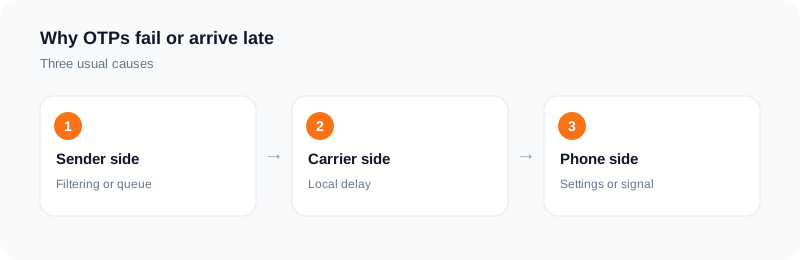
Is it my phone, my carrier, or the sender?
Work it out in this order, because the fix is different for each one.
Your phone. Check signal, check the inbox is not full, and check the message is not in a spam folder. If you can receive a normal SMS from a friend, your phone is fine.
Your carrier. If other SMS messages arrive but OTPs do not, the carrier may be filtering them. Try the same number on a different phone, or ask the carrier whether OTP messages are being blocked. DND settings are the first thing to check.
The sender. If the same service fails for everyone you know, or fails only for your number type, the sender is the problem. A service that blocks VoIP numbers or shared public numbers will never deliver to that number, no matter how long you wait.
The number itself. If the code arrives on a friend's number but not on yours, the number is the problem. A shared public number that hundreds of people have used is easy for a service to recognise and block. A private number rented for one order is not shared with anyone else during that order.
What should I try first when the code does not arrive?
Do the cheapest checks first, in this order.
Wait. Delivery depends on the sending service and the carrier route. A code can be slow without anything being wrong. Give it a few minutes before you do anything else. Check the number. Copy it from the dashboard, paste it into the app, and confirm the country code matches. A number entered with the wrong country code, or with the code typed twice, will not receive anything. Check the phone. Signal, inbox space, spam folder. One of these is the cause more often than people expect. Check DND and filters. If your carrier has a do-not-disturb setting, turn it off for the test, or check whether OTP messages are being filtered.
If all four are fine and nothing has arrived, the problem is the sender or the number, and the fixes below are next.
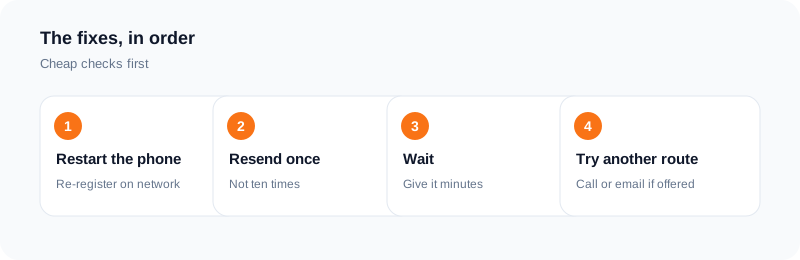
The fixes, in order
Fix 1: Request the code once, and only once. Repeated requests can trigger the app's own rate limits. A rate-limited account stops receiving codes entirely, sometimes for hours. Request once, wait, and only request again if the window is running out.
Fix 2: Change the country. If the service rejects the number, try a different country. A number from the country the service expects is more likely to be accepted than one from a country it does not expect.
Fix 3: Change the number type. If the number is a shared public number, switch to a private number. If the number is a VoIP line, switch to a private non-VoIP mobile number - a mobile number on a carrier network rather than an internet-based line. Acceptance is still decided by each service, not by the provider.
Fix 4: Use a private virtual number. When the sender will not deliver to your personal number, or when your personal number is blocked by the service's filters, a private virtual number is the practical route. The code arrives in your dashboard in the browser, over the internet, with no carrier filtering and no SIM involved. Pick the service and the country on the dashboard, and the number is assigned to your order only. A one-time activation lasts 20 minutes; if the account will ask for codes again, rent instead.
Deep troubleshooting for every failure reason is a separate guide.
What if the OTP arrives after it expires?
It happens, and there is no way to use an expired code. The service will reject it, and requesting the same code again will not help - it is the same expired code.
The fix is to request a new code, once, and to make sure the new one arrives inside its window. If codes are consistently arriving late, the problem is the delivery route, not the code. Change the country, change the number type, or use a private virtual number whose delivery does not depend on the same route.
Do not keep requesting codes in a loop. Each request can trigger rate limits, and a rate-limited account is worse than a slow one: it stops receiving codes at all.
What if the service never sends the code?
Then the service has decided not to send it to that number. This is not a delivery failure - it is a refusal, and no amount of waiting will fix it.
The refusal is usually about the number: VoIP, shared, wrong country, or a number the service has blocked. The fix is the same as Fix 2 and Fix 3 above: a different country, a different number type, or a private number. If the service refuses every number type you try, the service may be blocking temporary numbers entirely at the moment, and no provider can work around that.
Frequently asked questions
Why is my OTP late in Pakistan?
Usually international routing, carrier filtering, or the sender's own delays. Wait a few minutes, check DND and the spam folder, and confirm the number is entered correctly. If codes are consistently late, change the number type or the country.
Can I receive an OTP online in Pakistan without a SIM?
Yes. A private virtual number receives the code in a dashboard in the browser, over the internet. You do not need a SIM card in your own name or a local plan. The code appears next to your number as soon as it arrives.
Is a virtual number better than my personal number for OTPs?
For accounts you keep, your personal number is still the right choice for recovery. For extra accounts, testing, and sign-ups where the sender will not deliver to your personal number, a private virtual number is the practical route. A free public inbox is not: anyone can read the messages on a shared number.
How long is an OTP valid?
Most OTPs are valid for a few minutes. If the code arrives after that window, it is useless, and you need to request a new one.
What is the difference between SMS Activate and SMSOTPS?
Both are our own brands for the same kind of service: private temporary numbers for SMS verification. SMS Activate is at smsactivate.uk and SMSOTPS is at smsotps.com. The delivery fixes in this guide work the same on either one.
My OTP arrived but the app says it is wrong. What happened?
Either the code expired before you typed it, or a newer code was sent after it and the app only accepts the newest one. Request a new code once, wait for it to arrive, and type it in immediately.
Ready to try it?
Open the dashboard to see the price for your service and country before you order.
Open the dashboardKeep reading
Related services
 Telegram verificationCreate a Telegram account without exposing your personal phone number.
 WhatsApp verificationVerify WhatsApp with a private second number instead of your everyday SIM.
 Google / Gmail / YouTube verificationVerify a new Google account, Gmail address, or YouTube channel without your main number.