Open Source VoIP Providers That Support SMS Verification (Short Codes)
Developers · By SMS Activate Team · Draft - not yet published · 7 min read
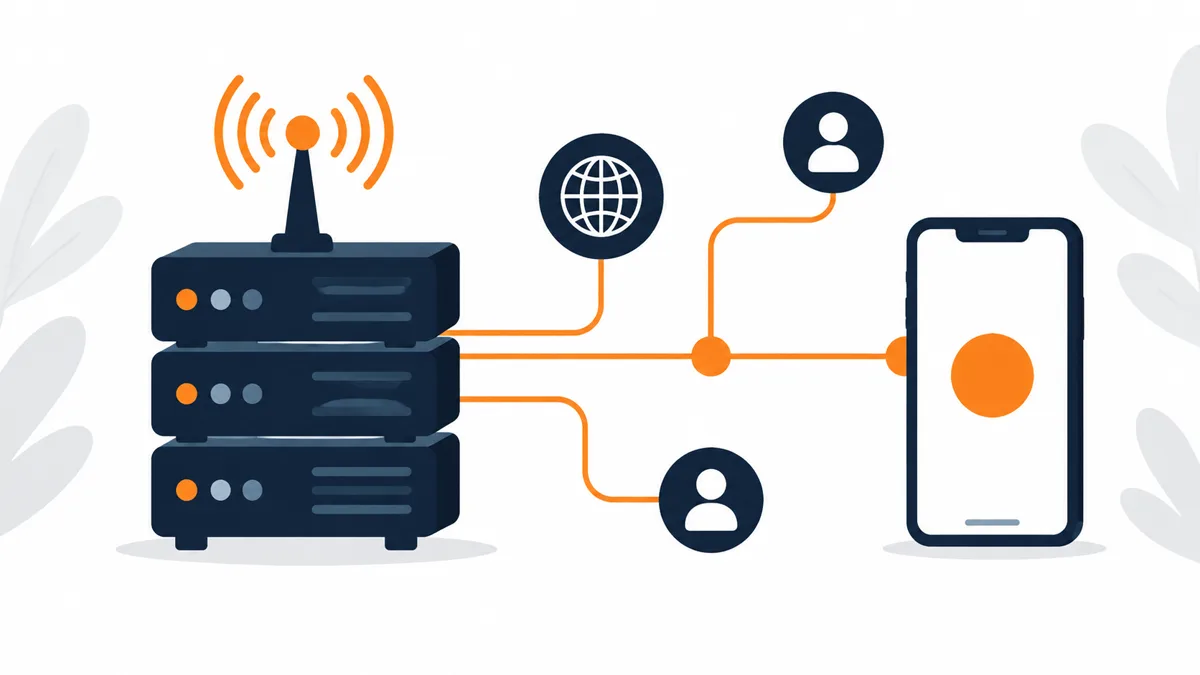
The honest technical answer up front: open-source VoIP software does not change whether you can receive verification SMS. The software is a tool for running a phone system. The number behind it is still a VoIP or virtual range, and most short-code senders - banks, big platforms, messaging apps - filter or reject VoIP ranges by policy.
"Open source" does not change the acceptance problem. The deciding factor is the number type - a real mobile, non-VoIP number versus a VoIP line - not the software you run. This guide explains what short codes are, why they are filtered, what self-hosting can and cannot do, and the practical route when a service demands a mobile number.
Can open-source VoIP receive verification SMS?
Sometimes, for some senders, and never reliably for short codes.
A VoIP system that can receive SMS can receive a verification code from a sender that does not filter VoIP numbers. That is a narrow case. Most verification senders that matter - banks, large platforms, messaging apps - check the number type before they send, and they filter VoIP ranges. When the sender filters, the code is never sent, no matter how good the software is, how well the server is configured, or how much you paid for the setup.
The software is not the problem. The number is. And the number is the part open-source software cannot fix, because the number type is decided by the carrier that issued it, not by the software that answers it.
What is open-source VoIP, really?
Open-source VoIP is software that runs a phone system on your own server: it routes calls, handles SIP connections, and can receive and send SMS through a carrier or a gateway. You install it, you configure it, you control it. It is a legitimate tool, and it is good at what it does.
What it does not do is change what kind of number you have. The software sits on top of a number. The number comes from a carrier, a range, and a type - mobile, VoIP, virtual - and that type is fixed when the number is issued. Running open-source software on your own server does not turn a VoIP number into a mobile number. It turns a VoIP number into a VoIP number that you control.
That distinction is the whole guide. People searching for open-source VoIP for verification are usually trying to solve a number problem with a software answer, and the software cannot solve it.
What are short codes, and why are they filtered?
A short code is a short number - usually five or six digits - that a service uses to send messages to many people. Banks, platforms, and messaging apps send verification codes from short codes because short codes are built for high-volume, one-way messaging, and because they are harder to spoof than a random long number.
Short-code senders are the strictest senders in the system, and they filter for a reason. A short code is often used for money, for account recovery, and for two-factor security. The sender has a strong interest in making sure the number receiving the code is a real mobile number belonging to a real person, not a virtual line that anyone can rent for a few minutes.
So short-code senders check the number type. If the number is in a VoIP or virtual range, many of them refuse to send. The refusal happens on the sender's side, before the message is ever sent. Your server never sees it, your logs show nothing, and no amount of configuration will make the sender change its mind.
Does the number type decide?
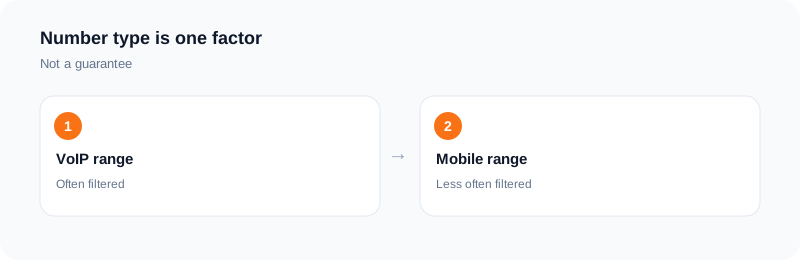
Number type is one possible factor - not the whole decision, and not something your software controls.
Some services check the type of a number - whether it looks like a mobile, VoIP, virtual, or landline number - before sending a code. Others weigh more than the number type, and any service can change what it checks. Your server, your software, and your configuration do not determine that decision - but neither does the number type alone.
A non-VoIP mobile number is a mobile number on a carrier network - physical SIM or eSIM. A VoIP number is an internet-based line, and it is the kind of number many services filter out. Neither type comes with a guarantee: each sender decides, and its policy can change.
This is one reason the same open-source setup can work with one sender and fail with another. The software is identical in both cases, and the number can be identical too. What can differ is the sender's policy - and the sender's policy is the part you cannot control.
What can self-hosting actually do?
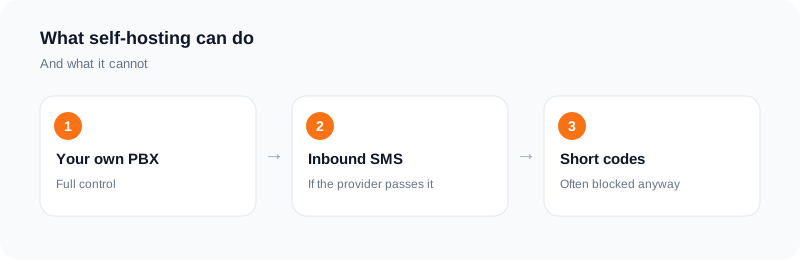
Self-hosting an open-source VoIP system is useful, and it is worth being clear about where it is useful.
Your own test traffic. If you are a developer testing SMS flows between systems you control - your app sends a code, your server receives it - a self-hosted VoIP setup is a fine test tool. You control both ends, so the acceptance problem does not exist.
Your own messaging. If you need to send and receive SMS for your own service, to users who have given you their numbers, a self-hosted system can do that, as long as you are sending to real mobile numbers and not trying to receive verification codes from third parties.
Learning and control. Running the system yourself means you see the logs, you control the routing, and you understand the flow. For a developer, that is valuable in itself.
What it cannot do is make a third-party service accept a VoIP number. That decision belongs to the sender, and the sender does not know or care what software you run.
What can it not do?
It cannot receive a short code from a sender that filters VoIP ranges. It cannot turn a VoIP number into a mobile number. It cannot make a bank accept a number the bank has decided to block.
It also cannot do the things people often assume it can:
It cannot guarantee delivery. A VoIP number that receives codes from one sender may be blocked by the next. There is no configuration that fixes a sender-side filter. It cannot make a number private in the way a private activation is private. A VoIP number you control is yours, but it is still a VoIP number, and the sender's filter applies to the type, not the owner. It cannot receive codes for accounts you have already lost access to. If an account only accepts codes on an old number, a new VoIP setup does not recover it.
The cost is real, too. A self-hosted system needs a server, a carrier or gateway, configuration, and maintenance. That is a real investment for a tool that does not solve the acceptance problem. Before you build it, ask whether the problem you are solving is a software problem or a number problem. If it is a number problem, the software is the wrong tool.
The practical route when a service demands a mobile number
When a service demands a mobile number - and most services that send short codes do - the practical route is a private non-VoIP mobile number.
The code arrives in your dashboard in the browser, or through the API, and the number is private to your order while it is active. A one-time activation lasts 20 minutes. If the account will ask for codes again, rent the number for the period shown in the dashboard instead. Prices vary by app, country, and current tier, and the final price is shown before you confirm. Prices are in US dollars.
SMSOTPS, at smsotps.com, is our own second brand for the same kind of service.
The honest limit applies here too: even a real mobile number carries no guarantee. Each service decides which numbers it accepts, and its policy can change. What a private non-VoIP number gives you is a mobile number type instead of a VoIP line - nothing more, and no software changes the sender's decision.
Frequently asked questions
Can I use open-source VoIP to receive WhatsApp verification codes?
Whether WhatsApp accepts a specific number is decided by WhatsApp, and its policy can change. A VoIP number is the type WhatsApp is most likely to reject. No number type comes with a guarantee: WhatsApp decides, and its policy can change.
What is the difference between a VoIP number and a virtual number?
The terms overlap. A VoIP number is an internet-based line. A virtual number is a number that is not tied to a physical SIM in your phone. A non-VoIP virtual number - a mobile number hosted for you on a carrier network, physical SIM or eSIM - is a mobile number type rather than an internet-based line. The deciding factor for filtering is not whether the number is virtual; it is whether it is VoIP or non-VoIP. Acceptance is still each service's decision.
Can self-hosting help me receive short codes from banks?
No. Banks are among the strictest short-code senders, and they filter VoIP ranges by policy. A self-hosted system does not change the number type, so it does not change the bank's decision. Your personal number stays the right choice for banking.
Is open-source VoIP software free?
The software itself is open source, which usually means no licence fee. The number, the carrier, the server, and the maintenance are not free. The total cost of running a system is higher than the software price alone, and it does not solve the acceptance problem.
What should a developer use for testing SMS verification?
Use the provider's own test path: a small wallet top-up, one cheap activation against a test account, and the API to read the code back. That tests the real flow - the number type, the delivery, and the refund rule - instead of testing a setup that behaves differently from production.
What is the difference between SMS Activate and SMSOTPS?
Both are our own brands for the same kind of service: private temporary numbers for SMS verification. SMS Activate is at smsactivate.uk and SMSOTPS is at smsotps.com. The number-type facts in this guide apply to both in the same way.
Ready to try it?
Open the dashboard to see the price for your service and country before you order.
Open the dashboardKeep reading
Related services
 Telegram verificationCreate a Telegram account without exposing your personal phone number.
 WhatsApp verificationVerify WhatsApp with a private second number instead of your everyday SIM.
 Google / Gmail / YouTube verificationVerify a new Google account, Gmail address, or YouTube channel without your main number.